We made it to Albion and I’ll update you on that in the next post. But, as I was going through my pictures they reminded me of some stories we heard along the way that I want to share with you.
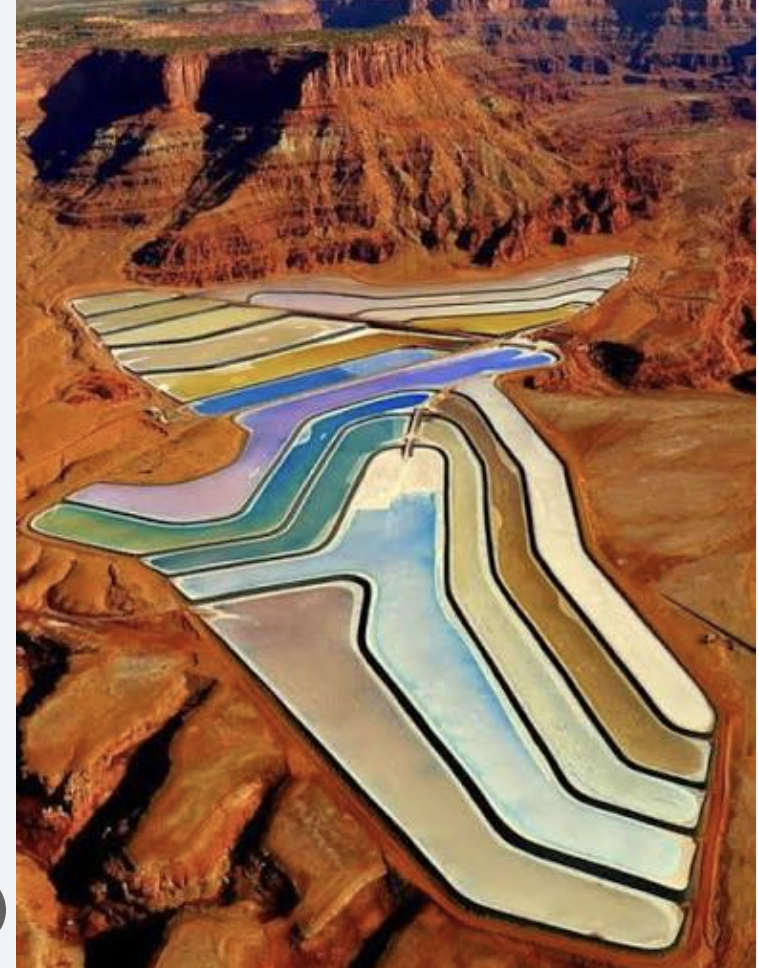
Potash is pronounced POT-ash because it was originally obtained by boiling a mixture of ore in cast iron pans….pot ash was what was left. It is primarily used (95%) to make agricultural fertilizer as it’s main ingredient is potassium. It’s mined by drilling into a ore, flooding it and pumping out the resulting slurry. The slurry is piped into ponds where it evaporates and….voila! potash!
The levels in the sandstone that were pointed out to us looked aqua-greenish to me.
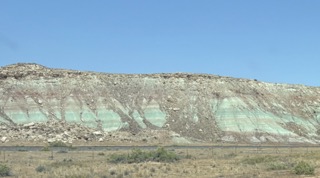
But, Gemini says that the ore is actually pink or reddish in color. Our guide said that blue dye is added to the slurry ponds and we spotted one far in the distance. The picture I captured from the internet seems to prove everyone correct!
But uranium is what put Moab on the map.
Charlie Steen, a geologist, discovered a massive strike in 1952. (More about him later!) Roughly 16 million tons of raw uranium were processed between 1956 and 1984 producing only 40 million POUNDS of “yellow cake” uranium for nuclear weapons and nuclear power. You might have guessed that the ore is yellow….and was used by native tribes as war paint. They did not become radioactive. The raw ore contains less than 1% of U-235 isotope that releases nuclear energy.
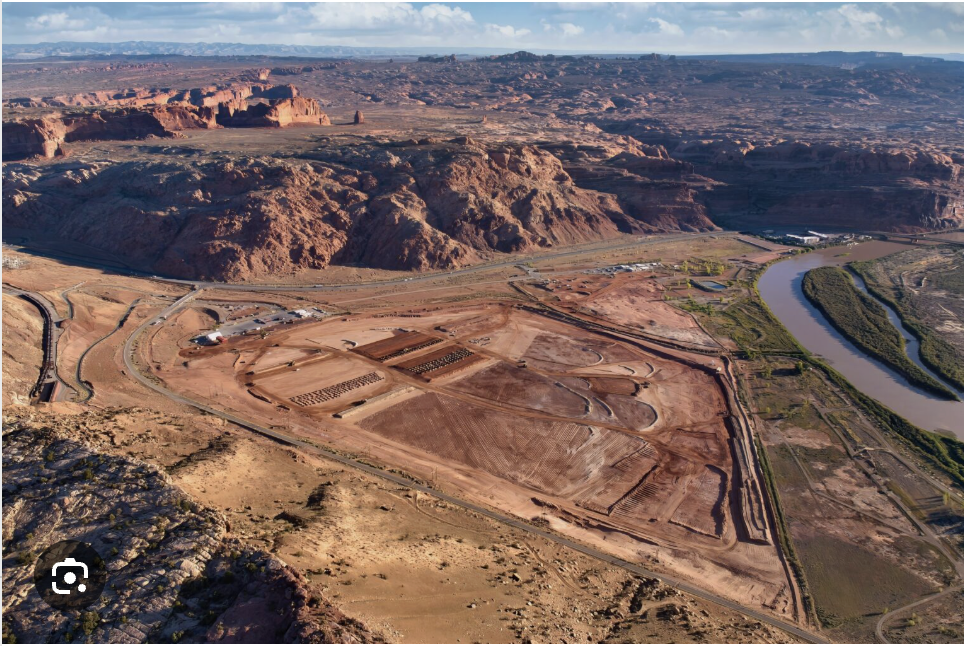
The part that wasn’t valuable uranium, called “tailings,” was left behind. Today there is a massive clean-up operation underway because the 130 ACRES of tailings eventually contaminated the ground water. The tailing piles were 80 feet high! The clean-up process was started in 2008 and surface pilings were removed by 2009 but the remediation required to solve the ground water contamination will take until 2029 to complete. Because the location is so close to the Colorado River, contamination was also detected there. This photo (also from the internet) gives you an idea of just how close!
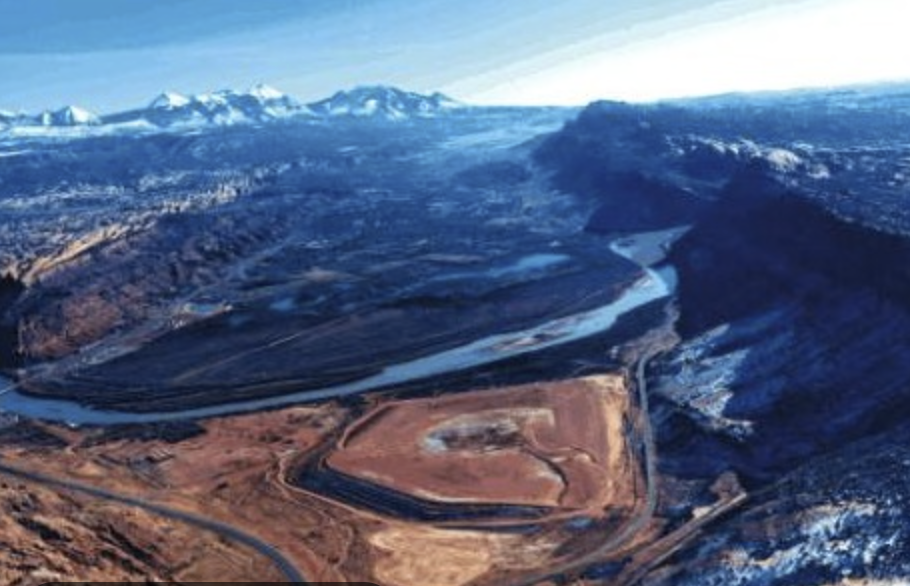
The photo below shows what the site looked like when they were mining. You can see that the actual area required to process the ore is a tiny part of the 480 acre mining site.
Now….back to Charlie Steen. In 1952 he was a penniless prospector. His is an example of the saying “striking it rich.” He became a multi-millionaire nearly overnight. This story will give you an idea of his wealth: TV reception wasn’t very good in Moab. So when his family wanted to watch their favorite weekly show, he would fly them to Las Vegas.